
Wood End Light on The Spit
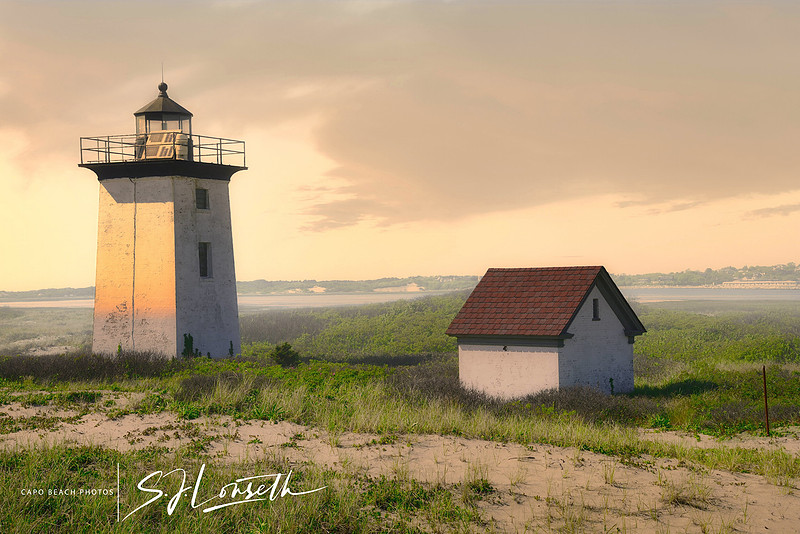

Wood End Light 0n The Spit -
The sandy spit at Provincetown Massachusetts has been described as a loose right handed fist shape. It protects the harbor from the larger Cape Cod Bay and the Atlantic Ocean. Navigation around the spit can be treacherous and deadly.
So it was proved on November 10, 1871 with the sinking of the oyster schooner William H. Atwood when 6 crew members lost their lives due to the hurricane force winds that tore their ship apart onto the spit. Towns people were helpless to save any of them. No bodies were ever recovered. Some historians arguably call that year the worst maritime disaster year on record for Cape Cod. But 1927 also claims to hold a similar distinction with the collision of the Navy Submarine S-4 with 42 men aboard and the Coast Guard Cutter Paulding. All the submarines' crew were lost, trapped when it sank in 110 feet of water. It took 18 days to recover the vessel due to high winds and icy conditions.There have been over 50 shipwrecks in the Cape Cod area since 1875. Race Point Light, further south on the spit was first built in 1816 and Long Point at the northern tip of the spit in 1927, but each had gotten subsequent rebuilds and upgrades. Wood End had been a lookout station at its current location by 1864, but the nearest access for help was walking 6 miles to Race Point Light in soft, difficult walking sand. The present day stone causeway or breakwater connecting the spit to town was not built until 1911. Even so, that was one mile long and only accessible at low tide.
The U.S. Congress was convinced that more advanced maritime aids were needed after the 1871 wreck of the Atwood schooner and appropriated funds of $15,000 to build the Wood End Light tower and so it was constructed in 1872. In the lantern room was a fifth order Fresnel lens on a 39 foot high square pyramidal brick tower originally painted brown. The light could be seen 13 miles out to sea on a clear day. It was not until this location became a full multi-manned life-saving station, storage shed, oil house and 2-story light keeper's wood framed house in 1896 that it became fully functional to perform life saving rescues.
The first light keeper at Wood End Light was a Massachusetts retired civil war decorated Quartermaster sergeant by the name of Thomas Lowe. After finishing his war service in 1865, he was hired by the U.S. Lighthouse Board and stationed at Highland Lighthouse also on Cape Cod. He rose through the ranks to become head Lightkeeper but remained at Highland until he was transferred to Wood End in 1872 when it was built. He served for 25 years until his retirement in 1897 and was responsible for saving many mariners' lives. He would on occasion have to depend on help from the town folk to help assist in a sea rescue but his faithfulness as head Lightkeeper was unwavering and appropriately recognized by the Lighthouse Board with multiple awards and metals of heroism . A true American hero.
Wood End Light was fully automated in 1961 and became the first Massachusetts lighthouse to be totally solar powered in 1981. It remains an active aid to navigation guiding mariners safely into Provincetown Harbor.
Personal Side Note for reference: If you venture this walk across the breakwater yourself, you need to be aware of a few tips. . . I started the one mile long trek across the stone breakwater from the mainland at around 2:00pm on a Tuesday afternoon in order to take the photograph you see in this blog. High tide I knew was at around 5:30pm. The breakwater took me 45 minutes to walk with no stops. Now that may seem like a lot of time for a one mile walk ( and I took no breaks), but the stones have large gaps between, gaps that require some jumping. Good shoes with traction are a must. (This alone should deter a short-legged person I think, such as my wife at 5'-2" height, i.e. she decided not to venture out which was a good thing). Then another 45 minutes out on the beach through loose dry sand to get to the Wood End Light. After about 20 minutes walking around the Light, taking photos, resting for ten minutes, I was ready to walk back again. There are no water sources and no restrooms. I was about 3/4 the way back on the breakwater when I realized I was very close to not finishing the trek due to the high tide. Several low areas on the breakwater were now underwater and seaweed covered, i.e slippery. These were stones I now needed to step onto in order to make it over those high water covered low areas. I felt quite tenuous about it. Beware if you venture out over this breakwater. Timing is everything. It is doable, but requires close attention to tides and caution over those larger rock gaps. Not for the faint of heart. . . .

