
The Queen Mary and Foxtrot-540
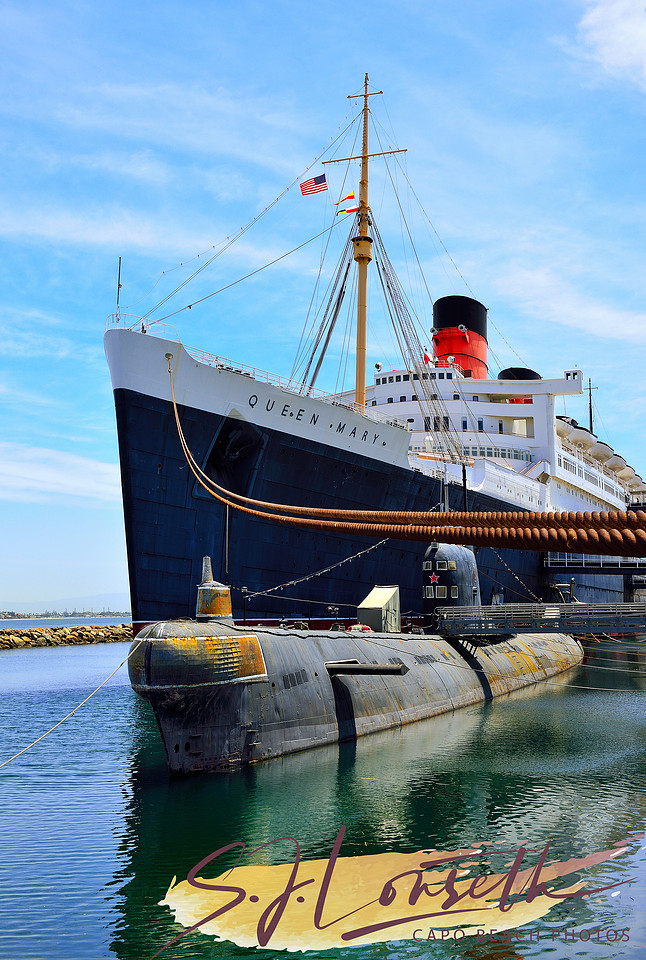

The Queen Mary and Foxtrot-540
The historic British ocean liner Queen Mary operated from 1936 until 1967. Built in Clydebank, Scotland on the Clyde River as Hull Number 534 and initially registered in Liverpool, England, the QM1 was the world's largest ocean going commercial passenger ship at the time. Completion took 3 1/2 years and cost $17.5 million to build, equivalent to $320 million dollars in today's money. In her sea trials she sailed at a speed just under 33 knots, the fastest ocean liner on the open seas. The Queen Mary made its maiden voyage between Southhampton and Cherbourg France on May 27, 1936 with a capacity of 2,140 passengers. After a forced merger by the government between the White Star Line and the Cunard Line it primarily spent its commercial life traveling the North Atlantic Ocean from mainland Europe and New York.
Along with another ship in the Cunard-White Star Line called the Queen Elizabeth, the two ships together held a choke hold on TransAtlantic passenger service between Europe and New York for over two decades until the dawn of the jet age in the late 1950's. For obvious reasons, the winter and spring routes of the two ships sailed significantly south of the Titanic's route in April of 1912.
During World War 2, the QM1 had been converted temporarily into a troop carrying ship and set a record in 1943 for the most people carried on a single vessel at one time, 16,683. The record still holds today. During her troop carrying years, the QM1 carried a total of over 800,000 troop personnel.
Today the Queen Mary is permanently docked in Long Beach, California and serves as a hotel and museum.
The Queen Mary 2 was launched into service in January 2004 in an effort to replicate the successful novelty of ocean travel from Europe to New York as did the Queen Mary. It is the largest single purpose driven ocean liner in existence today. It is 15% longer, 14% wider and almost doubled the tonnage of the QM1. It has an ocean going top speed of around 30 knots, carries 2,648 passengers with a crew of 1,236.
Alongside the Queen Mary in Long Beach is docked the Cold War Russian Pacific Fleet submarine known more commonly as the B-427 (hull number) Scorpion. NATO had a reporting designation of Foxtrot for this class type of diesel-electric patrol submarines. The Soviet designation was Project 641. A total of 58 of these type Project 641 patrol subs were built for the Soviet Navy beginning in 1958 and ending in 1983. There were a total of 75 subs built altogether. Other Foxtrot class subs were also built for Libya, India, Poland, Ukraine and Cuba. In fact during the Cuban Missile crisis in October of 1962, four Project 641 submarines were deployed by the USSR to Cuba and U.S. destroyers were successful in dropping practice depth charges on 3 of the Soviet subs to force them to surface but a fourth evaded detection. All four eventually returned to safely to the Soviet Union.
The Foxtrot class of submarines was one of the last sub designs before the more contemporary "teardrop" hull designs. They were almost obsolete before the first one even saw any service. The propulsion was from 3 diesel-electric engines and had a smaller back-up engine in case of total power failure. The 3 shaft, 6 blade prop design was slow and noisy and the submerged top speed was just over 16 knots due to its heavy operating weight with the excessive battery storage. Two of the three interior decks were full of batteries to provide the power. The sub was also cramped and crowded with a total crew of 78 and designed with 10 torpedo tubes, 6 bow and 4 aft.
The B-427 Scorpion was decommissioned by the Russian Navy in 1994 and sold to a group of Australian businessmen and converted into a museum vessel, and renamed to Foxtrot-540 which was the subs last NATO pennant number while it was still in service. It was relocated to Australia at the Australian National Maritime Museum from 1995 until 1998. Then in 1998 it was loaded onto a heavy-lift freighter then bound for Long Beach, California. The leasing company operating the Queen Mary in Long Beach took leasing ownership of the renamed Podvodnaya Lodka (meaning "submarine" in Russian) B-427 Scorpion and berthed it next to the historic Queen Mary and both served as museum marketing attractions until 2015. In 2016 the submarine was found to have severe hull (steel) rupture and flooding. It has been condemned by the City of Long Beach and closed to the public.
The submarine was just previously owned by NEWCO Pty Ltd. and leased to Urban Commons. Despite deteriorating conditions of the submarine, there are efforts underway to sell the vessel. The submarine may be demolished / salvaged in place since inspections have determined it would not survive a tow-away effort.

