|
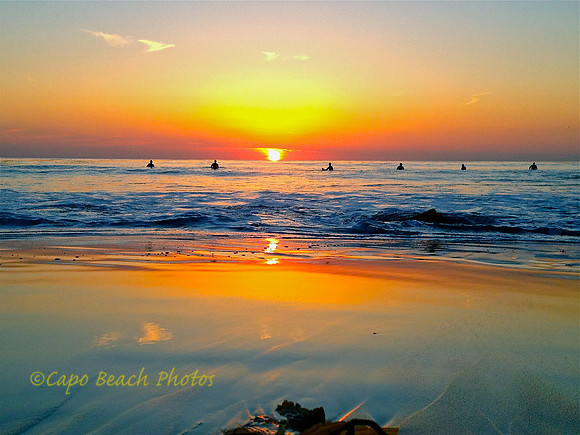
Bloggin' the Whole Story Thanks to everyone who frequents this website for the photos and blogs. On this blog site there will be a variety of photos and descriptive posts. Some posts involve extensive research, both from talking to locales and supplemented from the internet, while others are posted for the simple photo alone. Please enjoy and don't be afraid to give back your comments, good or bad. Surfer's Line UpSurfer's Delight A common occurrence in southern California especially in the summer months is to see surfer's in the water in a line-up at sunset waiting for that last big wave to make themselves feel golden about the day spent surfing. Or just catchin' that last one before calling it quits for the night. This was taken around 9:00pm on a late July evening at Salt Creek State Beach and looking west toward Catalina Island. Patience is certainly key when surfing, waiting for the next set of swells to make the day worth while. Even if you've just caught a choka (awesome) wave, the next one will always be better ! Sometimes there may be periods of dead calm before a new set of waves. In this photo, these six surfer's in particular are waiting for that next perfect wave at the end of the day. It's out there somewhere. . . . This photo is unusual for my website in that it is the only photo taken with my Apple iPhone 4S, 35mm equivalent focal length, shutter speed of 1/420 with f/2.4 aperture, ISO 64 and no flash. Little Stack of Bricks
The Old Point Loma lighthouse known as light number 355 of the 12th U. S. Lighthouse District, failed to be initially completed with construction funds appropriated by Congress in the year 1854. Funds totaling $90,000 were used to build eight lighthouses up and down the west coast of the United States due to expanding trade and shipping along the west coast. The California Gold Rush of 1849 had a major impact on west coast shipping. Point Loma was the last of the first eight to be constructed on the west coast but funds ran short in the final months of construction. It sat unfinished and without a lantern, lens or lightkeeper for over a year, high atop the west hill across from San Diego Bay, today known as Cabrillo National Monument. An editorial in the San Diego Herald in 1855 called the unfinished lighthouse a "little stack of bricks" on the hill. After having additional funds granted by Congress, it was first lit and became operational at sunset on November 15, 1855. The lantern and lens had been shipped to the site from Paris. The lantern room shown in this photo originally had a third order Fresnel lens showing as a fixed constant yellow light. Whale oil produced a yellow light compared to the later electric lights that were a pure white light. The lens was later changed out for a revolving one with alternate red and white lights. At the time it was built, the lantern room was the highest placed navigational light source serving as a lighthouse in the continental U.S. at a record 462 feet above sea level. This fact however also became its downfall in that the lighthouse was placed so high on top of the hill that eventually in March of 1891 it was closed in favor of the new lighthouse built at sea level below the high hill. The old lighthouse was so shrouded in fog and thick marine layer clouds most of the time that it was of little use as a consistent, reliable aid to navigation. During its 36 years in operational existence however it shown some 31 miles out to sea due to its height on the hill while standard lighthouses were limited to 19 miles out due to the curvature of the earth. Photo of the Old Point Loma Lighthouse lantern room taken with a Nikon S8200, shutter released at 1/400, aperture f/3.2 with a 24mm lens, ISO 100, with scattered pattern flash. Heavy Rocks
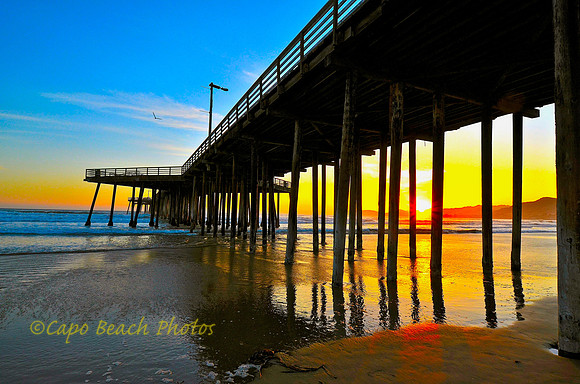
In 1881, the original Pismo Beach Pier opened for business. But not tourist business, commercial business. The Meherin Brothers and the nearby Arroyo Grande merchants were credited for starting this venture of a commercial pier intended to save the county residents and merchants thousands of dollars each year from the fees the large steamer line charged. Built for a cost of $14,613 as a result of selling $20 per share stock to local farmers and merchants, the pier quickly gained favor. By the end of 1882, with over 38 ships loaded and unloaded on the pier, county residents had saved over $35,000 in fees the first year alone. In 1892 however, a heavy load of bituminous rock waiting on the pier to be shipped to San Francisco for use in paving projects caused the wharf to collapse during an ocean storm. Finally in 1924 a new pier was built that extended 1,700 feet out to sea, enabling deep hulled Navy ships to unload personnel and load cargo. Another storm in the early 1930's destroyed about 500 feet off the west end of the pier and that portion was never repaired. The year 1983 brought another storm that would destruct so much of the pier that it needed major restoration in 1985-1986 at a cost of over $1,000,000. This is the pier that exists today, some 1,370 feet long and constructed using a combination of steel and wood pilings. It is built over one of the finest sand beaches in California. Digging for the Pismo clam is popular here though the clams have drastically decreased over the years due to over use. Today, the pier is used by many local recreational fisherman. In this sunset photo taken June 2012, several cantilevered fishing decks are shown. Popular fish species caught here include the snapper, bocaccio, croaker, calico surfperch, rubberlip seaperch, blackperch, sandsole, mackerel and halibut. Photo taken with a Nikon D7000, 24-75mm lens set at 24mm, 1/100th at f11 with ISO 200.
Run For Your Lives !
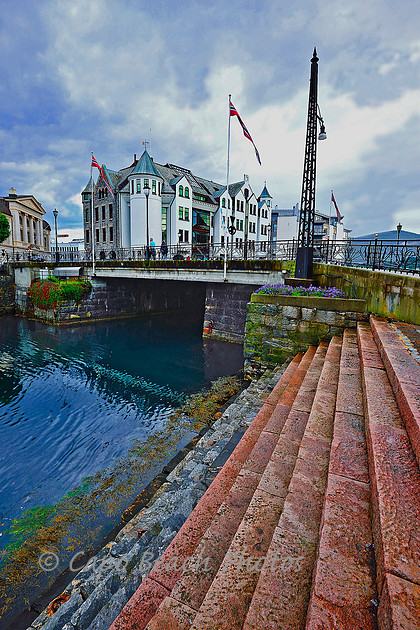
The fire started when everyone was sleeping. And of course they would be at 2:15AM. It was a blustery cold winter's night on 23 January 1904, and what started as a small fire from an overturned kerosene lantern at a margarine factory west of town would become a life changing fire for the inhabitants of the western Norwegian town of Ålesund. The town had only minutes to escape with their lives. The small town fire department was grossly unprepared for what was to come. The first alarm came from a manual fire pull station west of town and confirmed by the fire station's fire watch tower. Two horse drawn fire trucks were first dispatched but they were quickly overwhelmed. The glow from the fire was so bright and the smoke so thick, the horses had to be blind-folded in order to lead them toward the fire. The fire chief had to make split second decisions as to where to fight the blaze with his limited resources as the fire grew and the 50 mph winds fanned the flames and spread embers like a game of leap frog. In just 30 minutes the fire spread over 1 mile eastward skimming across the roofs of the wood framed structures in the town center, jumped over the town's Brosund or open water canal, about 1600 feet wide, and burned the town center to the ground. The town's only fire boat, a steam-driven vessel, tried desperately to suppress the flames that had engulfed the harbor structures. It was a losing battle. The town's water supply was unable to maintain the demand put on it by the multiple fire trucks. Before long, the water pressure was so low the stream from the fire nozzles could only reach to the bottom of the second floor of most houses. By the end of it all, 16 hours later, only 250 buildings of any type remained while 850 buildings were totally burned to the ground. Over 10,000 people were left homeless that night in the cold of winter. A 76 year-old woman died in the fire when she re-entered her house to retrieve her handbag. Rebuilding began in earnest in the fall of 1904 and by autumn of 1907, the rebuilding was virtually complete. Germany's Kaiser Wilhelm II was instrumental in this effort. The Kaiser had a very fond connection with western Norway and especially the town of Ålesund since he vacationed here often on his imperial yacht. It is recorded that before the last embers extinguished he had sent four warships loaded with materials, supplies, and personnel, enough to build temporary barracks housing for the homeless and providing food and medical help. His monetary assistance at the time helped rebuild this devastated township. The burned out wooden structures were replaced with stone ones. Along with this came architects, engineers, carpenters, stone masons and other craftsmen. Some 30 young Norwegian architects trained in Trondheim and some educated in Berlin, were eager to build structures in the Jugendstil (Art Nouveau) style architecture of the day. This style included gargoyle decorations, turrets, spirals, high pitched facades with arched windows and colonnades with metal and tiled roofs. Foreign aid came also from Sweden, Denmark, France and England. The Jugendstil style remains prevalent throughout the town center today, so much so that the town center appears like a classroom for the Art Nouveau style of architecture. In a national newspaper poll in 2012, Norwegians themselves voted Ålesund the most picturesque town in Norway. Wheel of Fortune
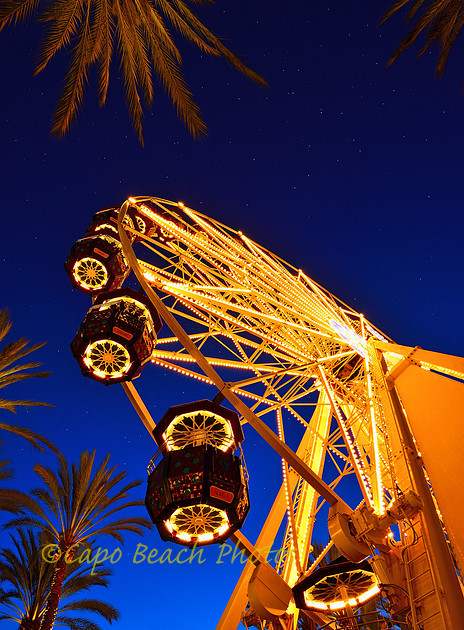
Ferris wheels as Americans have come to know them were made popular by an American bridge builder by the name of George Washington Gale Ferris, Jr. when he built a 264 foot tall rotating wheel as a landmark for the 1893 World's Columbian Exposition in Chicago. After the Fair, despite having found favor among Chicago residents who quickly dubbed it the Chicago Wheel, it was dismantled and later re-erected at the 1904 St. Louis World's Fair. The world's tallest Ferris wheel at present is the 550 feet tall High Roller located in Las Vegas Nevada. Several others are in the planning stages or soon to be completed including the Dubai Eye at 689 feet tall scheduled for spring 2015. Early versions of the giant wheel can be traced to several areas around the world including Italy, Romania, Turkey and Siberia. Early versions were made of only wood timbers and wood pegs but later combined wood and metal. Some were nothing more than experiments in disaster when either the support rings or chains securing the "cages" broke due to poor craftsmanship or being overloaded with occupants. The first recorded giant wheel in the U.S. was built by Antonio Manguino in 1848 at his start-up fair in Walton, Georgia. In 1892 three giant Roundabout wheels were erected by William Somers, one in Asbury Park, N.J, one in Atlantic city, N.J. and the third at Coney Island, NY. In 1893, Somers was granted a patent for his "Roundabout Wheel". After George Washington Gale Ferris rode Somer's Roundabout at Coney Island, he was so enthralled by it and being a bridge builder himself, he built the one for the Chicago World's Fair which was the tallest at the time. Somers filed lawsuit against Ferris but was unsuccessful since the parts and pieces for the "Ferris" wheel were different than for Somer's "Roundabout" wheel. Built at the Irvine Spectrum Center in southern California, this 28-car 108-foot tall Giant Wheel shown here in the night sky, was crafted and fabricated in Italy. It is just one of several attractions at this shopping center which also includes a carousel fabricated in San Francisco. The Spectrum Center itself was modeled after the famous Alhambra fortress and palace in Granda Spain. The photo was taken with a Nikon D800, 16mm lens set to F/20 and exposed for 2.5 seconds at ISO 800.
Medieval Trade
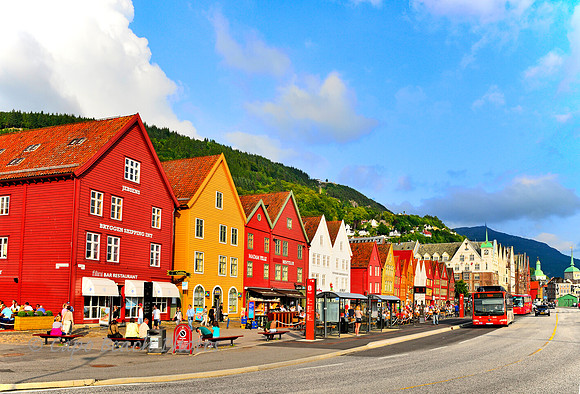
You might think these buildings along the wharfside of Bergen Norway look like just a bunch of old wooden buildings. You are actually correct. But how old ? Try almost 1,000 years old. These wooden structures date back to 1020 A.D., just 50 years before Bergen was incorporated as a city. Norway's capital was located in Bergen from the late 1100's until 1299. These old wharfside buildings are the remnants of what early merchants built in Bergen to do their business with oversea traders. It was an ice free harbor in from the harsh North Sea and was a free port for northern Norwegian traders to bring their goods. The majority of foreign traders were Germanic and by the early 1300's these buildings were taken over by the northern Germanic Hanseatic League. Trading included fish, both dried and fresh, textiles, foodstuffs, silver and leather goods. In Norwegian, the word "Bryggen" means the landing stage or wharf. It is also known as "Tyskebryggen" or the German wharf. The Norwegian dialect in this area has a very distinct hard sounding Germanic vernacular. Most of these structures and foundations remain from those early trading days though many have needed new roofs, siding and other replacement from weather and fires over the years. Recent excavations of one buildings foundations have revealed tools and utensils from the early trading days. Though the buildings lean, tilt, are twisted and look very rickety, they continue to be used by retail trading merchants. It is recorded that in the year 1349 AD the Black Death, that wiped out more than half the population of Norway, was inadvertantly brought to Bergen by an English trading ship. German influence can also be seen by the shape of the copper steeples on the buildings to the right hand side of the photo. Despite having visited Bergen many times over the years, I have always found it difficult to photograph Bryggen without people present, due to the fact it is one of Norway's most visited tourist attractions. Bryggen is on the UNESCO list as a World Cultural Heritage site. Not far down the road from this photo is the city's fish market that serves thousands of shoppers each day of the week. |