|
Bloggin' the Whole Story Thanks to everyone who frequents this website for the photos and blogs. On this blog site there will be a variety of photos and descriptive posts. Some posts involve extensive research, both from talking to locales and supplemented from the internet, while others are posted for the simple photo alone. Please enjoy and don't be afraid to give back your comments, good or bad. The Sensitive Carpenter
Located in Oppland County along the Otta River, this beautifully crafted Christian church in Skjåk Norway was completed in 1752. As a log timber constructed church it is a fine example of the wood craftsmanship found in many inland rural areas of Norway at the time. The area has a rich cultural heritage and is known to have been heavily settled during the Viking era. The area is known for its historical trade route as a low lying valley. The rainfall has to be supplemented by irrigation for farming due to its extremely low annual precipitation, ranked as one of the lowest in Europe. Keep in mind, however, lack of rainfall or snow does not equate to temperature. It is still cold during the winter months. What makes this church particularly intriguing is that it was built by a 25 year-old architect / carpenter by the name of Ole Rasmussen Holø. In addition to his skills, nine of the best carpenters in the entire rural valley were entrusted with the construction. He was so picky and meticulous about his carpentry style and craftmanship he removed and rebuilt several of the details the other carpenters had completed. The steeple was erected at night to avoid onlooker criticism. It is recorded that he would not put up with any criticism nor ridicule of his work. The interior furnishings are some of the finest woodworking carvings and paintings in all of Norway. The church was constructed during the Baroque period in Norway when decorative folk art painting known as Rosemåling was originating in Norway's rural valleys. Follow this link to see more: http://www.pinterest.com/livperschon/rosemaling/ Norway is particularly boastful of the artwork's origin though that has often been disputed by their Swedish counterparts. The decorative painting was almost always done on wood as is the case in this church interior. What makes it also unique is that no two pieces of work are ever exactly the same. It is an individual art form. Rosemaling uses stylized flower ornamentation, scrollwork, geometric lines and elements in flowing patterns and is said to contain in its very existence the magic and culture of Norwegian history dating back to the Viking era. A total of 23 well defined painted areas in this church interior still exist. Exhibits of these same craftsman's hand-painting work are on display at the Oslo Historical Museum. The Red Fishing Village of Bud
This tranquil scene is very typical for the small fishing village of Bud (pronounced Boo'd) on the west coast of Norway. It is located in Møre og Romsdal County on the Atlantic coastline. With a current population of only around 765, it has been a village since the early Middle Ages. In 1533, it was the largest fishing village between Trondheim and Bergen. Due to a good natural harbor and rich fishing grounds in the Atlantic, the village has always thrived yet has remained small and charming, attractive and endearing to tourists and Norwegians alike. Walking around this village was delightfully peaceful and picturesque. No traffic, no hoards of tourists, no rushing around of any kind by anybody. Just peaceful, very peaceful. This photo was taken looking westward out towards the Atlantic. The harbor remains quite sheltered from Atlantic storms. This goose was heading in towards shore to take advantage of a feeding opportunity where a local woman had come out of her nearby house to offer several slices of bread for the taking. It was obvious to me while standing there, this was a frequent ritual where the woman and the goose knew each other quite well. Traditionally, it is said that the color red is used in so many Norwegian buildings, especially barns, farm houses and boat sheds because it is left over from the old days when color represented one's status in life, their financial situation, geographic location and their profession. It also resulted from one's access to local resources. For fishermen, for example, the color red stemmed from fish blood and whale oil or cod liver oil. Red was definitely the most common color, the least expensive to produce and it spoke of a working class Norwegian. White on the other hand showed more wealth and class. The white color required expensive zinc to produce and showed off their wealthy status, like driving an expensive car.
The Love of His Life
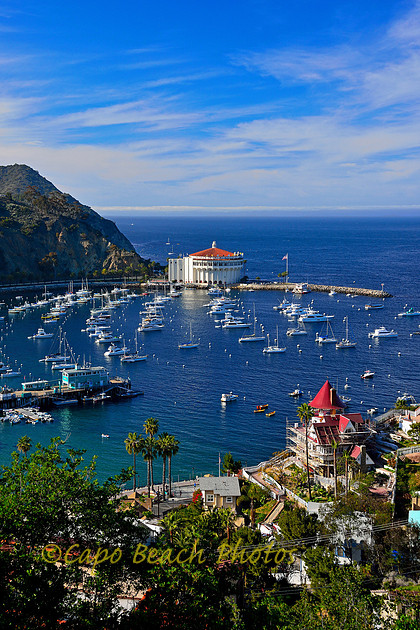
On the Island of Santa Catalina off the southern coast of California in Los Angeles County lies the Queen Anne styled Holly Hill House. The house is visible in this photo at the bottom right hand corner during a restoration project in 2013. Originally built by Peter Gano, a transplanted Ohioan and civil engineer, the house sits up the hill on the south side of Avalon overlooking the harbor. Gano built the entire house by himself as the story goes, with the help of a trustworthy friend, an old retired circus horse named Mercury. Mercury was tireless in his daily task of hauling supplies and building materials from the bottom of the hill up to the house via a rope and pulley system devised by Gano. Only the finest materials were used for construction. The house had alternating light and dark pine floors, redwood kitchen counters, burled redwood fireplaces, a 22 foot diameter, 40 foot high cone-shaped cupola and a sun porch surrounding the main floor. The average annual precipitation on Catalina is only 11.88 inches and being an engineer he had also built a groundwater and rainwater collection system that included a cistern under the house. Once construction was completed in 1890, he asked the love of his life to marry him and move to the island to live out their lives together. She was reluctant to move to the island and be isolated from the mainland. As months went by, Gano still held out hope she would change her mind and make a commitment to him and the house he had built for her on Catalina. During this time of waiting for her, he named the house "Lookout Cottage" and he waited, and waited. As the years went by, she finally married someone else and he realized he was destined to live in this beautiful house alone. The story is that in his later years, never having married, he posted signs all around his property proclaiming "No Women Allowed". Visible beyond, on the north side of the harbor on what was formerly known as Sugarloaf Point is the Catalina Casino. No longer a casino at all, it is now a theatre, ballroom, and museum.
Footsteps in the Dark
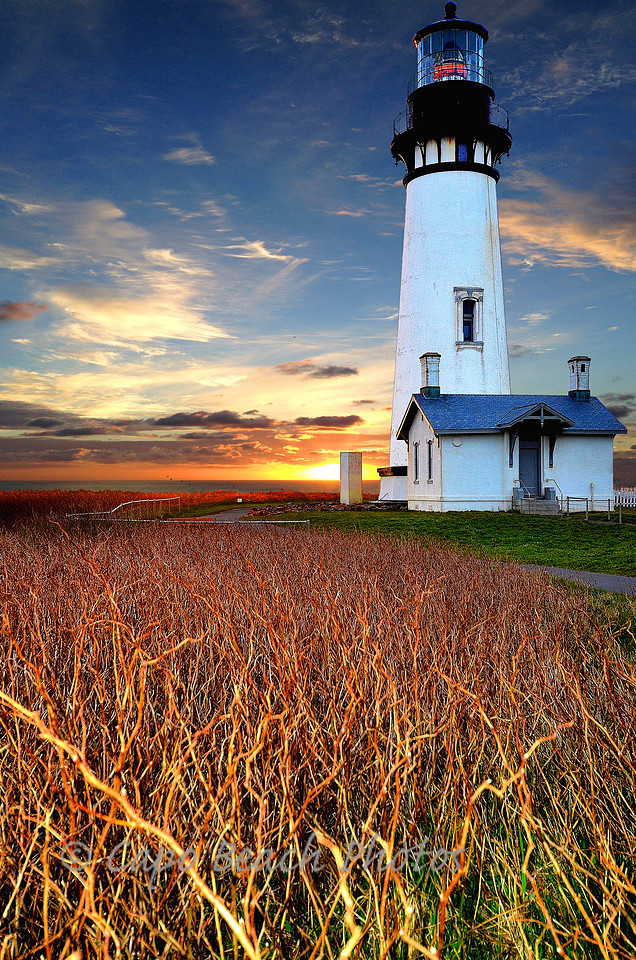
Standing 93 feet tall ( 28.5 meters ) atop a 162 foot seaside cliff, Yaquina Head is Oregon's tallest lighthouse whose illumination can be seen 19 miles out to sea. Since its completion in 1873, it was operated by the U.S. Lighthouse Board until 1939 when the U.S. Coast Guard took over the operations. Located near Newport, Oregon and constructed with over 370,000 bricks in double wall construction, its original first order Fresnel lens still remains today though no longer with oil burning wicks but with a 1000 watt theatrical globe. Every lighthouse has its stories, some good, some bad, and this one is no exception with its own particularly haunting tales. One story involves a workman who apparently accidently fell off scaffolding during construction and was buried in between the double brick wall cavity of the tower, and whose body was never retrieved due to it being inaccessible. Cries for help from within the walls were said to continue for several years after. The second tale, as it goes, involves two lightkeepers working on a cold and stormy January night in 1930 when the oil burning wick in the lantern room at the top of the tower had extinguished itself. The older lightkeeper was so inebriated he could not do the fairly simple task of climbing the stairs and relighting the wick. Though ill at the time, the younger lightkeeper had to get out of bed and walk the 114 stairs to the top of the tower to re-light the oil wick in the middle of the night. However, once he reached the top of the tower he collapsed and died. The older lightkeeper fearing vengence from that day forward always walked to the top with his bulldog for protection due to ghostly footsteps he would hear on the cast iron stairway at unpredictable hours both day and night until 1945. On the day WW II ended, the footsteps stopped. The deceased younger lightkeeper had been a war veteran from WW I. This photo was taken at dusk in April 2012 with a Nikon D7000, 28-300mm lens set to 28mm,1/60th at f/3.5 with an exposure compensation of +0.7.
Atlantic Road Highway
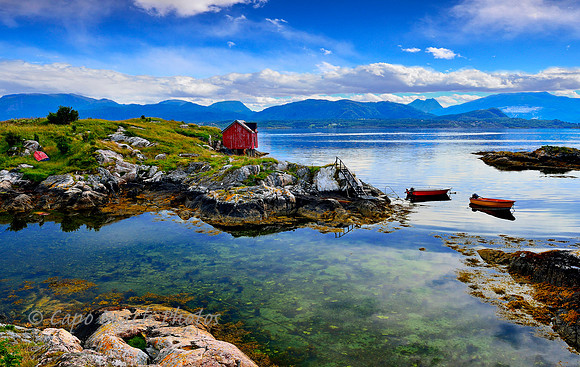
Traveling along the Atlantic Ocean Highway one realizes its scenic beauty and why it is a Norwegian national cultural heritage route. The Atlantic Road is a 8.3 kilometer long section of County Road 64 that runs through an archipelago in western Norway's Møre og Romsdal County. Due to the severe weather it endures unsheltered during the winter and the technological challenge that was required during construction, it has been awarded the title of "Norwegian Construction of the Century". See this link for photos of The Atlantic Road: http://twistedsifter.com/2012/05/the-atlantic-road-norway/ Driving north to Kristiansund last summer along The Atlantic Road I caught a glimpse of a secluded little boat house off in the near distance. Of course being a photographer, I MUST stop whenever and wherever the opportunity arises to photograph. Pulling off the highway, I realized it was a private driveway, so I parked the car and walked in to the residence I saw nearby. The homeowner was working on the roof of his house and quickly came down to greet me as I approached. I did not want to appear brazen about walking onto his property to photograph his boat house without his permission. While I do know some Norwegian I am by no means fluent with the correct "chit-chat". Since almost everyone in Norway under the age of 55 years old speaks and understands english pretty well, I decided to ask politely in english, explaining that I was from California and I wanted to take a photo on his property. "You do not have to ask, go take your photo, you are welcome to do so", he replied. Hmmm, very nice of him I thought. Well, the fact is that since 1957 in Norway there is code law that is termed 'all men's rights' ( women's rights too of course ) regarding walking on private property. This has stemmed from hundreds of years of practiced tradition. This practice comes with obligations and responsibilities to not harm, disturb, litter nor damage wildlife nor crops. Access rights are most often for travel on foot and not by vehicle. If you hurt yourself while walking, the problem is yours and yours only not the landowner's. You always enter at your own risk. You can not sue. Fortunately, no injuries were sustained by me while taking this photo ! Mendocino Sunset
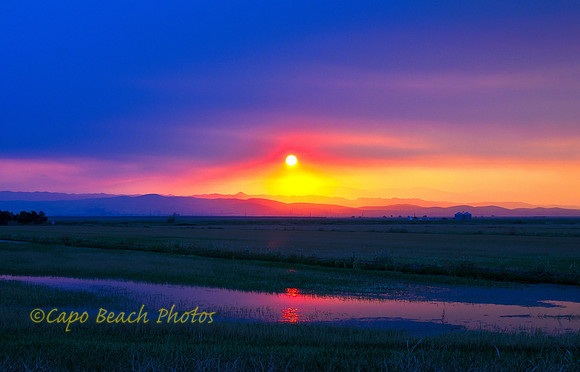
This sunset photo was taken on the evening of July 10, 2012 while traveling north to Seattle. It is three days after lightning started the fire in the 913,000 acre Mendocino National Forest. It was known as the Mill Fire and burned some 30,000 acres before it was contained. The fire was so intense in some campground areas that county roads were closed forcing campers to find alternate escape routes. Having seen the smoke from Interstate 5 near Willows, California I drove west from the freeway about four miles on a small county road only to find myself in the middle of rice-paddie fields. The air was thick with the smell of the forest fire. The lack of wind caused the lingering smoke from the fire to produce some distinctly rich and vibrant colors with the setting sun. |