|
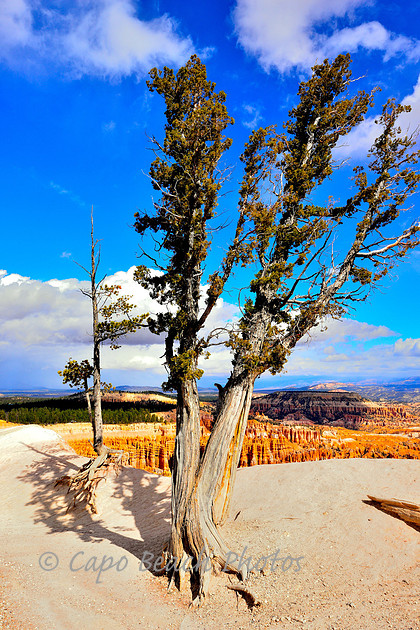
Bloggin' the Whole Story Thanks to everyone who frequents this website for the photos and blogs. On this blog site there will be a variety of photos and descriptive posts. Some posts involve extensive research, both from talking to locales and supplemented from the internet, while others are posted for the simple photo alone. Please enjoy and don't be afraid to give back your comments, good or bad. Older Than Methuselah . . . and Then someSeniority While visiting Bryce Canyon National Park in September of 2012, I walked along the Rim Trail edge of the amphitheater canyon some 800 feet above the canyon floor. It is said about the air quality in Utah and especially at Bryce Canyon that on a good day it is very easy to see as far as 120 miles in all directions, some days even further. On the day I walked the Rim, the view was very clear. While looking toward the southeast from Yovimpa Point, the south rim of the Grand Canyon was clearly visible though quite off in the distance. It is located 150 miles from Bryce Canyon. However, keep in mind the elevation where I was standing was some 9100 feet above sea level. The long distance views from the Rim of the amphitheater are like looking afar off over the curvature of the earth. The air was brisk on that September day yet pleasant. Great Basin Bristlecone Pine trees such as the one in this photo have stood here a very very long time. The park estimates this tree to be over 250 years old. Trees at this elevation do not grow fast, but they grow strong and hardy. Also known as foxtail pines, these hardy specimens definitely have seniority on our planet and have been known to out live every living thing on earth. Clonal colony trees such as quaking aspens have been known to live longer but for a single tree, the Bristlecone pine is the longest living single tree species. The oldest known Bristlecone Pine tree, affectionately known as Methuselah is estimated to have germinated in 2832 BC, some 100 years before the first Egyptian pyramid was ever built. See a link to the Methuselah tree (and this may be the tree): http://www.wired.com/2010/03/old-tree-gallery/2/ Located in the Ancient Bristlecone Pine Forest high in the White Mountains of eastern California at an elevation of about 9500 feet Methuselah is estimated to be some 4800 years old. This Forest of Ancients area is covered in snow eight months out of the year with sub freezing temperatures. The soil is terrible yet they survive. This had been the oldest living tree until another foxtail pine was discovered in 2013 that may possibly date to over 5100 years old. There are many of these trees in that forest and the exact location of the oldest trees are kept a secret by the U.S. Forest service in order to protect the trees from vandals. Biblical Methuselah was the son of Enoch and the grandfather to Noah. He lived to the age of 969. Methuselah, the man, died shortly before the Great Flood. Terrible Tilly - A Story of Death and the MacabreTerrible Tilly Tillamook Rock Lighthouse, some 134 feet tall, also referred to as Terrible Tilly, is arguably the most weather beaten lighthouse in the continental U.S. Completed in 1881 after some 575 days of construction by the Army Corps of Engineers, it was at the time, the most expensive lighthouse ever built on the west coast of the U.S. It got its nickname from the erratic weather conditions and the dangerously cumbersome commute for lightkeepers and suppliers alike. Decommissioned in 1957 due to its deteriorating conditions and the high cost of maintenance, the lighthouse was originally to be built at Tillamook Head but when the initial survey team realized the light would be shrouded in fog most of the year due to its position high on the cliff, the lighthouse was relocated to Tillamook Rock, a basalt rock island some 1.2 miles off shore. Seen in this photo from the beach head on the mainland, the rock and the lighthouse have seen many tragic events during their lifetime. While two earlier surveys recommended against the construction on this rock island, a third survey of the Rock took place during which the lead surveyor was swept out to sea while attempting to land by vessel on the rock. While there had already been public opposition to the construction of the lighthouse, this incident outraged the public even further. Work crews had to be sequestered on the island and on an offshore ship during construction for fear that public opposition and the stories of the accident would spook the workers. During the first few days on the island, the construction crew of five had to fight off angry sea lions who also opposed their presence. The mental and physical challenges of working and living on the island took their toll. Dismissals and turn-over assignments were frequent. One worker tried to poison another worker by grinding up glass in his food. Access to the island had become by way of a "breeches buoy" from ship to shore due to landings being far too precarious to be successful on a regular basis. This was done by cable from ship to the top of the rock. Mail and supplies were irregular due to storms and high seas. In another incident in early January of 1881 just twelve days before the opening, the ship Lupatia heading from Japan to the mouth of the Columbia River, some 20 miles to the north, with a crew of 16 and a dog aboard were violently shipwrecked during a howling gale. The ship had been so close to the island that the workers could hear the crew calling for help but could do nothing. The only survivor was the crew's shetland collie dog. The dog lived another nine years. Throughout its history, the tower itself was damaged by severe storms that broke out the lantern room glass and damaged the first-order fresnel lens. During one such 110-mph storm, surging waves had broken out the glass of the tower and lightkeepers were bailing water from the lantern room in order to keep the light from extinguishing. There had also been tales of voices heard coming from a mythical underwater tunnel from the mainland to the island as told by Native Americans in the area. Records tell tales of voices heard deep underground however no tunnel has ever been discovered. In 1980, there came a fittingly macabre twist to this lighthouse story. Two women bought the lighthouse and turned it into a columbarium. They planned a storage house full of urns of cremated human remains. Advertised as "Eternity at Sea", there was to be storage for 100,000 ash urns. The required urn niches were never built and by 1996, only 30 urns were housed there. The license for the columbarium was revoked in 1999 by the Oregon Mortuary and Cemetery Board due to improper storage and poor record keeping. Some urns were only placed on concrete block pedestals. Despite reapplication for the license, none has been reissued and the urns still remain on the island in an empty lighthouse surrounded only by birds and sea lions. The Sand Man
Nestled safely at Percival Landing harbor in Olympia, this venerable wooden tugboat hardly shows her age of 104 years. Originally built by Crawford & Reid shipbuilders in Tacoma Washington during the years from 1908 to 1910, for Arthur Weston, owner of Olympia Sand & Gravel Company, the Sand Man is the last of its kind. Back in 1910 she was one of many privately owned freight vessels swarming Puget Sound doing "hard time" pulling sand barges up and down the waterway. But now all from that era are gone, forever. She earned her name from towing those cumbersome sand barges. From 1925 to 1987 she had a succession of three commercial owners, yet doing the same kind of hard labor. Then in 1987 she was rescue purchased by a private individual who began restoring the old tugboat. However, ten years later the task proved too much for one individual to undertake and she was sold to the non-profit Sand Man Foundation which owns it to this day. During its restoration process, the vessel has survived two sinkings. At one point the hull was so decayed it leaked over a gallon of water per minute and when the bilge pump ceased working in 1998, it sank. It has had three engines in its lifetime, the last of which had been on board since 1944. It cruises at a speed of up to 9 1/2 knots, is just under 60 feet in length, holds 1280 gallons of diesel, and when fully fuelled weighs in at 37 tons. In this photo, the Sand Man is safely moored in Budd Inlet, Olympia Washington during a July squall that ripped through Olympia in 2012. This photo was taken with a Nikon Coolpix S8200 point and shoot pocket camera because it was all I had at the time. Despite having only a point and shoot camera for this moment in time, I could not let this image escape me. Ålesund Burns
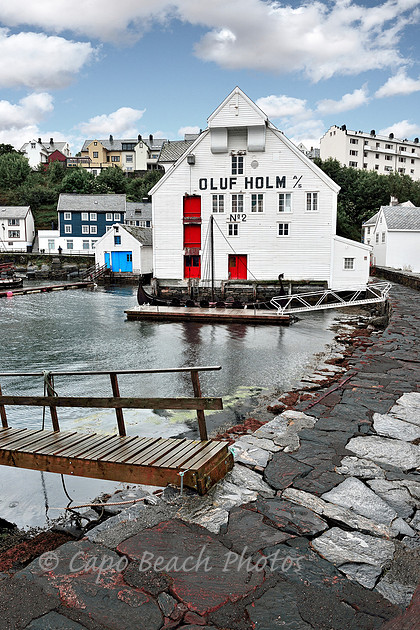
In the aftermath of the devastating fire in Ålesund Norway in the early morning hours of 23 January 1904, help came from an unlikely ally, Kaiser Wilhelm of Germany. He dispatched four large ships to the town loaded with laborers, medicine, equipment and materials for rebuilding the town. For many years he was a fervent tourist to the coast of Norway, visiting little townships and cruising the long fjords of Norway. One of his favorite townships was Ålesund. Help also came from fellow Norwegians but being a fairly poor nation at the time, foreign assistance was greatly needed. By early fall of that same year, the town's center was rebuilt of stone, tile, concrete and plaster in the German version of the Art Nouveau style, also known as Jugendstil. Young architects of Norway were greatly influenced at the time by this new contemporary style of the day as well as by the National Romanticism style that had captured their fancy showing off spires, turrets and ornamented facades. The entire town center of Ålesund consisting of 850 houses and other wooden buildings burned to the ground that night. Ten thousand left homeless that night. Only 24 houses scattered throughout town remained untouched. One of those houses belonged to a Norwegian by the name of Anders Nord. This is the tale, part of the town's records, combined with a German translation account of the fire from that night in 1904. Anders was a devote Christian who studied his Bible every day. His wife, on the other hand, was of weak faith. Ander's faith was strong in God's protection of his household and his faith would prove inspirational. He told his wife that despite the raging fire all around them that night, they should stay put and God would protect them. He was confident and insistent God would watch out over them despite the raging flames. His wife on the other hand did not believe her husband in this matter and moved most all of their belongings out of the house in a panic to a local park with help from family and friends. She did however leave for him his chair, a small table and his Bible in the house. Sixteen hours after the fire had started, the town center was totally gone, except for Anders and his house. Their furniture and other possessions, which the wife had taken to the local park, was nothing more than a heap of smoldering ashes. His wife brought the children back to the house very apologetic to Anders for her unbelief in what he had told her. The only casualty that night was a 76 year-old widow who lived next to the fire station of all places. The Oluf Holm building, also known as Holmbua ( Holm shed ) shown in this photo was located along the waterfront of Ålesund, but to the west from the town's harbor entrance. All the warehouse buildings in the harbor waterfront had been destroyed. Built in 1861 this warehouse had been owned and occupied from 1924 to 1986 by the Oluf Holm A/S Company, a prominent fishing wholesaler business processing cod liver oil, dried cod and the making of barrels to contain oil and salt-preserved fish. Today it is a fishing museum with exhibits that depict Norwegian deep sea fishing and the equipment used in that bygone era.
Custer's Last Stand
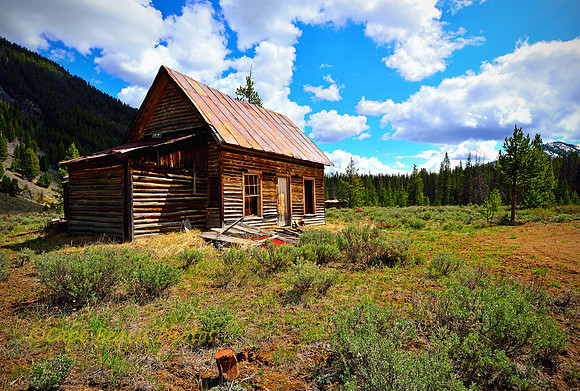
Nestled in the remote central Idaho county of Custer, the ghost towns of Bonanza and Custer were established in 1877 and 1878 when gold was discovered in a nearby mine by three miners. Bonanza sprung up first but nearby Custer followed a year later. One of the big mines and the town were named in honor of General George Armstrong Custer who had been defeated in the Battle of the Little Bighorn in eastern Montana a year earlier in 1876. Custer's Last Stand, as it is commonly referred to, resulted in the death of 268 infantry soldiers and scouts that were part of the U.S. Army's 7th Cavalry Regiment. Five of the 7th Cavalry's twelve companies including Custers, along with his two brothers and a nephew were annihilated in the battle. The town of Custer was a one street town that stretched for about half a mile. The town had an assayer's office (where they weighed the gold), livery stable, blacksmith shop, a school, post office, general mercantile store, a barber shop, jail, union hall, several saloons, houses and a Chinatown at the south end of town. Custer even sported a baseball team! By the year 1896, a total of 600 people called Custer home. Custer grew rapidly after a fire in 1897 destroyed much of nearby Bonanza. Between the years of 1880 to 1888, the General Custer mine produced over $8 million in gold. But such towns as these, founded on newly discovered riches do not last long and Custer and Bonanza were no exceptions. By the year 1903, the population of Custer decreased rapidly as the glory days were slipping away. The bigger mines such as the General Custer, Lucky Boy and Sunbeam began to dry up. By 1910, Custer was a ghost town. Custer, Idaho is within the Challis National Forest and lies along the Yankee Fork at an elevation of 6,470 feet. Currently the ghost town of Custer is listed on the National Register of Historic Places though only seven buildings actually remain and qualify for the status due to the town's deteriorating condition. Restoration efforts are under way to restore the town to its glory days. International Orange ? Really ?
Construction on the "most photographed bridge in the world", the Golden Gate Bridge, began in earnest in January of 1933 but the wrangling over issues such as funding, engineering design along with the political opposition lasted for almost 18 years prior to the bridge being completed on May 27, 1937. A bridge across this stretch of the Golden Gate Strait was essential to connect Highway 101 to Marin County and to connect the coastline between southern and northern California. The civil and structural engineering design required to build a span across this portion of the Strait was considered by many to be "a bridge that could not be built". Though never really getting full credit for the design until 2007, the principal engineer for the bridge was Charles A. Ellis in collaboration with Leon Moisseiff, a New York suspension bridge designer. So after many years of haggling over funding and despite the Great Depression of 1929, the citizens of six northern counties of California voted to finance the bridge. In 1971 the last of the original $35 million construction bonds was retired. A few fun facts: the twin towers reach to a height of 746 feet above the sea level with the pavement at 220 feet above the water. There are over 1.2 million rivets and over 80,000 miles of wire in the two main strand cables. Until 1964, the main span was the world's longest suspension bridge at 4,200 feet. While this blog could go on and on for pages about the bridges finer details, it will instead concentrate on the paint color of the San Francisco bridge: The paint color for the Art Deco style bridge was studied, analyzed and finally decided through a lengthy process between city officials, sculptors, artists, the military, engineers and architects. The color was not decided until 1935, just 18 months before the bridge's completion. The primary consulting architect of the bridge, Irving F. Morrow, made the push for the final color in his 29-page document called "Report on Color and Lighting" presented to the bridge's Board of Directors. But the permitting agency, The Department of War, also had to be convinced to paint this wild and crazy color. The U.S. Navy wanted to originally paint the bridge black with yellow strips to ensure visibility ! Morrow felt the vermillion orange that was used initially for the steel corrosion sealer, a shade variation of international orange, complemented the natural surroundings and enhanced visibility in the fog as well. While the wild color is a form of international orange it has enough of a shade variation to actually be unique onto itself. In 1937, over 10 million square feet of steel on the bridge was painted. Painting Golden Gate is done daily, but not from one end to another as most people think, rather it is touch-up paint maintenance issue, ongoing year after year, to stop the corrosion inherent with salt air. In 1968, the painting program changed from touch-up painting to removing the original lead-based paint and replacing it with an inorganic zinc silicate primer with a vinyl topcoat. However, in 1995 the vinyl was replaced with acrylic emulsions due to the concerns of high VOC's (volatile organic compounds). International orange is a color widely used in the aerospace industry and by the U.S. military, though shades can vary. See this link for details about international orange: http://en.wikipedia.org/wiki/International_orange This photo was taken at the lookout point called Battery Spencer, a former military overlook in Marin County expressly installed to protect the bridge and the strait during WWII. The photograph: Nikon D800, with 28-70mm lens focused to 44mm on a tripod, 1/50th at f/14, pushed to ISO 400.
|