|
Bloggin' the Whole Story Thanks to everyone who frequents this website for the photos and blogs. On this blog site there will be a variety of photos and descriptive posts. Some posts involve extensive research, both from talking to locales and supplemented from the internet, while others are posted for the simple photo alone. Please enjoy and don't be afraid to give back your comments, good or bad. A Fishing Village
The Island of ONA was once a thriving population of 50. Over the last six decades it has dwindled to about 40. Once considered a great location for accessing the abundant fishing banks of the northern Atlantic, the fishing community of the island suffered from the decimation of the Northern Atlantic Cod due to environmental reasons as well as over fishing. As a result, profits from fishing decreased to the point that a basic living could no longer be sustained. Fishing boats still work off this island but in limited activity. Over the past twenty years or so, the island has maintained a steady increase in tourist trade with artist studios and pottery shops. The island is small enough that tourists can easily walk the island without a car. On the south island of Husøy exists an ancient Viking burial ground. The island is really two islands, the larger island of Husøy and the smaller island of Ona, jointed together by a small bridge over a 15 meter wide waterway. The ferry docks on Ona. Upon docking, one is immediately greeted by the presence of the prominient red painted cast iron lighthouse built on top of a rock cliff in 1867 which still operates but is now automated. The light only operates from August through May because the remaining months are lit by the midnight sun. The rock cliff outcropping the lighthouse is built on is named Onakalven. Accessed only by ferry four times a day, the excursion from the west coast mainland takes about two hours and stops at several other islands on the way. A very pleasurable trip if you should ever decide to visit the west central coast of Norway. Eureka Slough Railroad Bridge
One of a Kind - The Eureka Slough bridge just off Highway 101 in north Eureka is owned by the Southern & Northwestern Railroad. It is now abandoned due to a deteriorated condition and has be deemed unsafe for all kinds of traffic. It has been replaced by another bridge nearby. Originally built as a tower swing bridge in 1916, it was revamped as a extremely simple vertical lift deck plate girder bridge in 1972. The total length of the 19 foot wide bridge is 720 feet, yet the lift portion is only about 90 feet in length. In this photo, the remnants of the old swing bridge center round pier can be seen still retaining the original ring gear elements. When it was revamped, it became the only vertical lift bridge in the State of California that operated without cables, pulleys, or counterweights but rather hydraulically by way of a diesel powered compressor. The abandonment of the bridge has led to colorful graffiti signatures considered by some locals as an eye sore but as a treasured historical landmark by others. Early Morning in Kolob Canyon
Kolob Canyon in the morning light - An early spring morning in Kolob Canyon, Zion National Park West. From the Visitor Center at 5076 feet we headed up the Kolob Canyon Road past Paria Point and the Lee Pass Trailhead, then up to the Timber Creek Overlook Trailhead, elevation about 6200 feet, and 2 1/2 miles from the visitor center. The area had just gotten a dusting the night before and the air was definitely brisk and invigorating. Looking east here across Timber Creek Valley to the Timber Top Mountains. Portland Head Lighthouse at Dusk
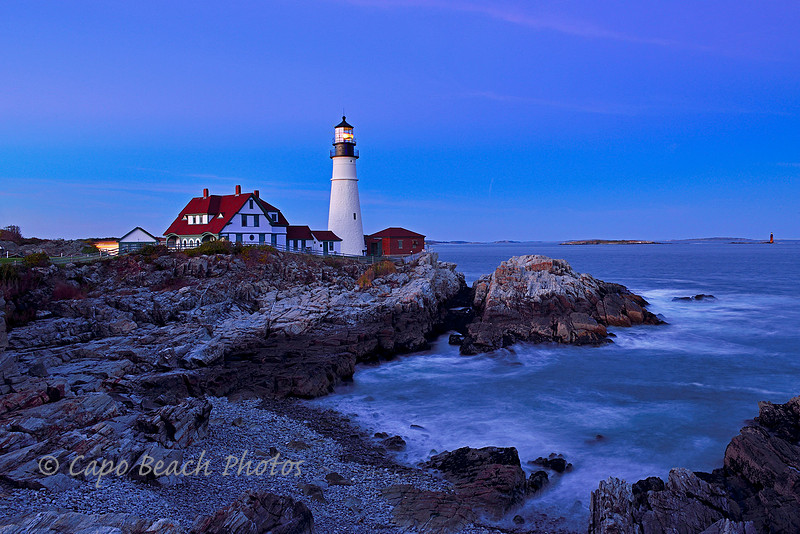
in 1787, at the personal direction of George Washington, two masons from Falmouth (modern-day Portland) were given the task of building a lighthouse with a fund of $1500 in under four years. Because the fledgling government of the United States started out with very little money, Washington told the masons to use local materials they could find along the shore and from nearby fields. The tower was built of rubblestone and was to be 58 feet tall according to the plans they were given. However, when completed and the masons climbed to the top of the tower they realized it was too short and the light could not be seen beyond the nearby headlands. They raised it another 20 feet and that problem was solved. George Washington appointed the first light keeper Joseph Greenleaf in 1791 who was a patriot that found favor with the first president. For the first two years of his duties, Greenleaf was not paid the money owed him. He died in 1795 while still the lightkeeper. To the far distant right in this photo can be seen the Ram Island Ledge Lighthouse built in 1905. It was built on a series of rock ledges that had become treacherous to navigate around while entering the harbor. It has a twin known as the Graves Light in Boston. The lighthouse was built of granite quarried from Vinalhaven, Maine. Not much granite comes from there anymore, now it is mainly lobster. The lighthouse was put up for sale in 2010 and after no interest was shown by locals nor government organizations it was sold to a private citizen for $190,000. Bodie Island Lighthouse Along the Graveyard of the Atlantic
Bodie Island Lighthouse - It was 1837 and something had to be done. Scores of ships were in constant peril along the Outer Banks of South Carolina due to treacherous navigation along the Carolina's coastline. So many shipwrecks in fact that the area became known as the Graveyard of the Atlantic. What few residents there were here at the time would find bodies washed-up on shore as a fairly common occurrence. There were multiple attempts to build lighthouses in the area north of Cape Hatteras, the first of which were on Pea Island south of Oregon inlet. The first Light began construction in 1847 but had to be torn down in the early 1850's due to a leaning foundation. Another replacement completed with a better foundation in 1859 was blown-up by Confederate troops in 1861 retreating to the south during the Civil War fearing the lighthouse would be used by the oncoming Union troops as a lookout that would give away Confederate troop locations. But in 1871 a permanent replacement had begun just south of Nags Head South Carolina at Bodie Island. Completed in 1872, this lighthouse would drastically reduce maritime casualties from tragic ship wrecks. The current 165 foot tall light was built with bricks from Baltimore and ironwork from a New York foundry. It was equipped with a first order fresnel lens bright enough to assist mariners setting their course regardless of whether they were navigating north or south of Cape Hatteras. Lighthouse keepers had their share of ordeals when they first arrived, not the least of which was the fact it was secluded with the only access by way of boat. Families of the light keepers lived on nearby Roanoke Island where their children could attend school. They would visit for the summers only. Venomous snakes populated the high grass areas around the lighthouse property. Even today there are elevated walkways for visitors to avoid the snakes while strolling the surrounding areas around the lighthouse. Weather on the Outer Banks also led to extremely high ground water and tidal surges during treacherous winter storms. In 1932 the lighthouse was automated and control of it was transferred to the National Park Service in 1953. The lighthouse has undergone several renovations the most recent of which was in 2013 and it remains an operational navigational aid. |