|
Bloggin' the Whole Story Thanks to everyone who frequents this website for the photos and blogs. On this blog site there will be a variety of photos and descriptive posts. Some posts involve extensive research, both from talking to locales and supplemented from the internet, while others are posted for the simple photo alone. Please enjoy and don't be afraid to give back your comments, good or bad. Campobello Island Lighthouse
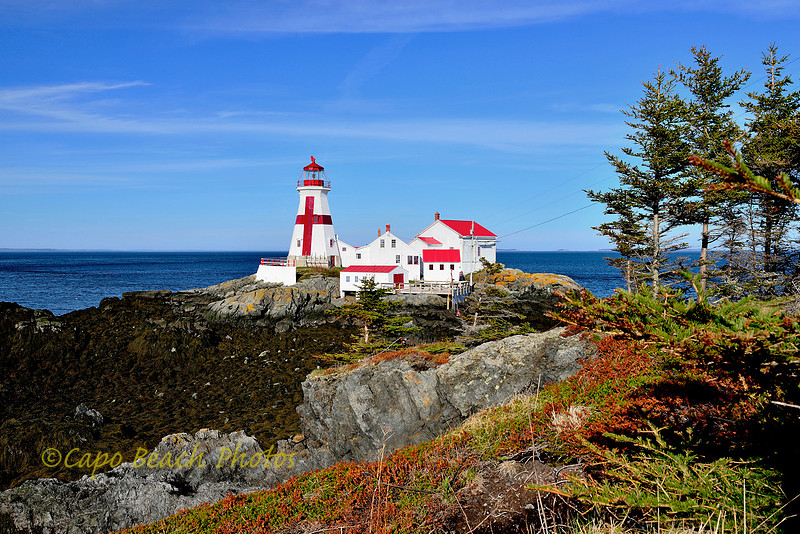
The lighthouse is only accessible at very low tide and located just a few miles from what was once Franklin D. Roosevelt's summer cottage on Campobello Island in New Brunswick, Canada. Situated precariously on the very north end of a small islet at Head Harbour on the Bay of Fundy 9.2 miles from the U.S. / Canada border just north of Lubec, Maine, the island is only reached by crossing over the FDR Memorial Bridge leading from Lubec. The entire island is a dead-end, so the only way off the island is the way you came in. The 40 square mile island has 925 permanent residents whose main livelihood is fishing. Life here is quiet and serene. No one is in any hurry to go anywhere or do anything. This is rural life at its finest ! The historic Roosevelt family thought so too because they had owned property on this island since 1883, vacationed here every summer including President Roosevelt who had known this island since he was one year old. In August 1921 while staying in his 34 room "cottage" he had purchased on the island, Roosevelt was diagnosed with Polio; the disease that crippled him for the remainder of his life. The 1960 movie "Sunrise at Campobello" starring Ralph Bellamy and Hume Cronyn is filmed on the island and on the Roosevelt estate in Hyde Park New York. It begins in 1921 when FDR was stricken and paralyzed with polio while vacationing on the island and shows his rise to power up to the 1924 Democratic National Convention. He would continue his rise to power to become the 32nd president of the United States, spanning from 1933 until his death in 1945. The Campobello Island Lighthouse was only Canada's second lighthouse at the time and is also known as East Quoddy Lighthouse and Head Harbor Light Station. The main tower exterior is shingled wood and still stands since built in 1829. It has a third-order fresnel lens that displays as a steady red light which can be seen 13 nautical miles out to sea. The symbolic red cross of "warrior saint" St. George is painted on it's 51 foot high tapered tower wall as a channel daymarker for passing ships trying to navigate the Bay of Fundy and Passamaquoddy Bay. When my wife and I first arrived at the Canadian border on Campobello Island, we told the border patrol we would only stay a few hours, but they thought that suspicious and odd. To the point that we were asked to park the car and go inside for what amounted to a one hour question/answer session, most of which amounted to just waiting. Odd you might say ? Seemed odd to us anyway since the lighthouse, we thought, was a tourist attraction after all ! Nonetheless, the visit to this remote rural Canadian island and the resulting photographs were worth the interrogation process. We looked and acted like a typical American couple from southern Orange County California. But seems strange enough I guess when you think about it. . . here we were, all the way from California to a remote New Brunswick Canada island just to look at a lighthouse that has been there since 1829. Dangers Ahead
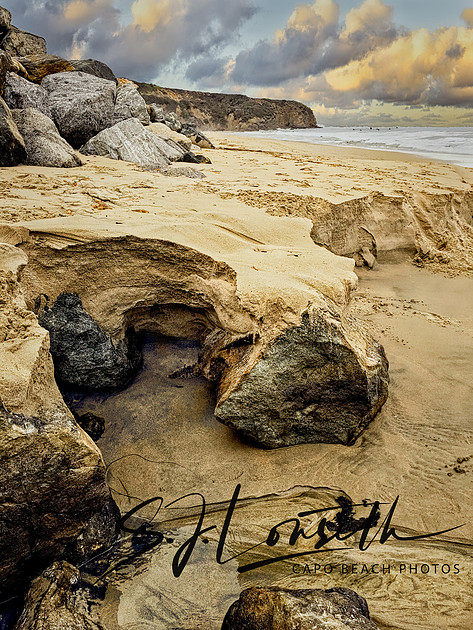
As many of you already know, my wife is a talented and published author. She has written and published several Christian fiction novels which are the beginning of a five book mega series saga. Many of you have read her first two novels that are part of this saga and I'm sure you are looking forward to the remaining books to be published in the very near future. She works steadily on her story lines. Like every worth while author, she painstakingly nurtures them to the point of perfection, which of course is never attainable, but she persists nonetheless. She loves to tell stories, always has, and so authoring books from her imagination, loosely based on her own life experiences comes natural. What has not come natural of late is the difficult task of telling our own real life events with the dreadful disease so many in our current generation are facing. That is, the insidious diseases of dementia and Alzheimer's. Her completion of the five book saga has been slowed recently by her desire to share the tale of what it is like to care for family members with dementia. Both my own parents and hers were inflicted with memory disease in some form. Her latest book titled "The Dangers of Denial" will be released on October 14. It's a booklet really, because the idea of writing a long book discourages even the reading of it. She wants her booklet to help people who are in desperate need of answers. The booklet deals with the denial of memory disease that so many Americans and people around the world are experiencing. The booklet sheds light on dangers that come from family members and even the patients themselves who deny having the disease, laugh it off or who shrug it off as just one of life's afflictions such as senility, that will just run its course or will go away. The problem is that it will never go away and the disease only gets worse not better. There is no making the patient better. While the disease will progress at its own pace, fast or slow, there are significant ways families can deal with this in an appropriate and humaritarian fashion that makes the reality of it less burdensome. The photo above is the cover to my wife's latest booklet, again, titled "The Dangers of Denial" that will be released on October 14. We both felt this photo depicts the symbolic affects of not only what happens to the victim of the disease but also what begins to happen to the family who struggles with the disease's consequences. The photo was taken at Strand Beach in Dana Point, facing south toward the Strand Headlands beyond. It was shot on a January day last winter after a very stormy night with high surf and extreme high tide. The beach had eroded and collapsed in several places and showed signs of complete erosion. What was a typically pleasant calm beach landscape in southern California one day became totally unrecognizable the next day. Please visit my wife's website to read more about her books at: http://www.elizabethlonsethnovels.com/ The Nubble in Deep Space
As an icon and classic American lighthouse simply known as "Nubble", this stalwart lighthouse is. . . Famous. So much so that the Voyager I spacecraft, launched in 1977, on its initial voyage to photograph our solar system, carried a photograph of this, The Cape Neddick Lighthouse onboard to show it as one of man's prominent structures. Other photos included The Great Wall of China and the Taj Mahal. All in hopes that, if discovered by intelligent extraterrestrials, it would show signs of what man has built on planet Earth. Before its inception, The Nubble Lighthouse was talked about and planned since 1837. It wasn't until 1874, after numerous tragic shipwrecks, that Congress finally appropriated $15,000 for its construction. The U.S. Lighthouse Service dedicated the Light in 1879 and it has been in service on this islet ever since. Of the 60 lighthouses remaining in Maine, it is one of only eight that still operates with its original Fresnel lens. Sheathed with a cast iron shell lined on the interior with brick, the lighthouse stands 44 feet tall but hovers 88 feet over the rocky cliff and sea below. The lighthouse is closed to the public but can be reached on foot at low tide. It sits just 100 yards off shore at Cape Neddick Point in the Village of York Beach, Maine. This photograph was taken in the early evening hours as the sun was beginning to set. My wife and I rushed north along Highway 95 from Logan Airport in Boston, like Bonnie and Clyde escaping a bank heist, to catch the lighthouse before dark. In all fairness to my wife and her always calm demeanor, I should say I rushed, she was just along for the ride. We found only two other couples at the Cape when we arrived so that made for uncluttered photography. On board the exterior of Voyager 1 in 1977 was attached a "Golden Phonograph Record" with several iconic hieroglyphs on the face. The Record had 116 images of earth and what life is like here. It included a photograph of The Nubble Lighthouse, sights and sounds of earth, images of symbolic gestures, people, animals and plant life but also had 55 modern and ancient languages. On Valentine's Day 1990, with its original mission completed and on its way out to deep space beyond Pluto, Voyager 1 turned to take a "family portrait" of our solar system. In that photo was a tiny blue dot which was Earth. American astronomer Carl Sagan chaired the committee for NASA that decided what was to be placed on that Golden Record. Of that tiny blue dot, Carl Sagan said this: "Consider again that dot. That's here. That's home. That's us. On it everyone you love, everyone you know, everyone you ever heard of, every human being who ever was, lived out their lives. The aggregate of our joy and suffering, thousands of confident religions, ideologies, and economic doctrines, every hunter and forager, every hero and coward, every creator and destroyer of civilization, every king and peasant, every young couple in love, every mother and father, hopeful child, inventor and explorer, every teacher of morals, every corrupt politician, every "superstar," every "supreme leader," every saint and sinner in the history of our species lived there – on a mote of dust suspended in a sunbeam". Go East Old Man, Go East
West Quoddy Light - Known as the candy striped lighthouse, this USCG operated aid to navigation stands guard over the Quoddy Narrows several miles south of the Canadian border near Lubec Maine and is the easternmost lighthouse in the continental United States. From these lighthouse grounds one can see a small rock formation several hundred yards off shore named Seal Rock, that is literally the eastern most terra firma still called the United States. Standing on this rock formation, you can not get any closer to Europe and still be standing in the U.S. Originally built at this location in 1808, it was replaced with the present day 47 foot painted brick conical tower in 1858. A keeper's house was also built in 1858 along with a fog signal house in 1887 and oil shed in 1892. The lighthouse was automated in 1988 and has the only remaining third order Fresnel lens of any Maine lighthouse. In 1990 the United States Postal Service commemorated the lighthouse on a 25 cent stamp. Seeing the high altitude jet plane just to the left of the lighthouse, one can only imagine it en route from some part of Europe. Run Forrest Run !
Run Forrest Run ! At a young age the fictional Forrest had to walk with leg braces. When he encountered those bully kids that were throwing rocks at him because of his infirmities, he began to runaway from them to avoid not only the stoning, but the humiliation he was suffering in front of a female childhood school friend. Grasping her school books tightly, she cried "Run Forrest Run". His leg braces were cast-off as he began to run faster and faster away from the bullies, leaving them in a cloud of dust despite the fact they were on their bikes. Eventually he would run everywhere. And I mean everywhere. Never mind he was a naive, simpleton sort of fellow, he loved to run and oh could he run. Sitting on the porch one day when he was older, he just decided to run again, just a little ways at first. But it wasn't to be just a little ways, he decided to keep on going, all over the country, non-stop for two years, two months, 14 days and some 16 hours when finally in Monument Valley of Utah he decided he was tired now and was going home. So it is that during his journey to just run, Forrest Gump ran from the 107 year-old Santa Monica Pier on the Pacific Ocean, cross country to the Marshall Point Lighthouse in Port Clyde Maine on the Atlantic Ocean. While the movie was filmed here in 1993 and was released in 1994, the original lighthouse dates back to 1832. The 20 foot tall, 1832 version of the lighthouse here was set too far back from the water's edge and shoddily made of rubble stone and did not last. So in 1858, it was rebuilt out to the ocean's edge as far as possible on the St. George Peninsula overlooking Penobscot Bay. It was established to light the entrance to Port Clyde Harbor, a thriving port at the time, exporting lumber, granite and fish. The rebuilt tower is the present day lighthouse and is 31 feet tall and built of a granite foundation and white-washed brick with a 5 sided cast iron lantern having a fifth-order Fresnel lens that showed a fixed white light. The elevated wooden walkway extending out to the lighthouse was also covered with a wooden structure but was later removed. In 1895 the keeper's house was destroyed by lightning and a new house built which is the one that stands today. Automated in 1971, the house and lighthouse stood neglected for many years until restoration began in 1986. For a total of 45 years, from 1874 until 1919, a Civil War veteran by the name of Charles Clement Skinner served as the keeper. In the records of the U.S. Lighthouse Service, this is the longest tenure of service at the same lighthouse in U.S. history. He and his wife lived here with their 6 children, one son and five daughters. In their latter years, the two youngest daughters lived in a house in nearby Warren that their father had originally built. They both attended the restoration ceremony of the keepers house in 1990. The youngest lived to 102 years of age. The sunny day was beautiful when this photo was taken, no one else around and with perfect scenery. The camera is a Nikon D800 with a 24-70mm lens, set at 24mm to get the full breadth of the scene from the porch of the keeper's house looking southeast out toward the lighthouse and Muscongus Bay , handheld, f/16 at 1/50s, no filters, ISO 200 in full matrix focus. Faithfully Unfaltering
Steadfast, serene, immovable, the same, Year after year, through all the silent night Burns on forevermore that quenchless flame, Shines on that inextinguishable light ! - - from "The Lighthouse" (1850) by Henry Wadsworth Longfellow
Born in Portland Maine, American poet Longfellow was a frequent visitor to the Portland Head Light. His poem "The Lighthouse" was written as a tribute to his fondness of it. He would often spend hours sitting on the rocks, watching heavy seas roll in or chat here with his friend Captain Joshua Freeman, the fourth lightkeeper at Portland Head. George Washington, as one of his duties of being the first U.S. President of a fledgling young country in 1787, commissioned the Portland Head Light to be built at the jetty of land projecting out into the Atlantic, southwest of Portland Harbor at Casco Bay. It was not only the first lighthouse of a new country but also Maine's first lighthouse once it broke off from Massachusetts in 1820. Construction was started with only $750 allocated by the State of Massachusetts but then supplemented with $1500 from the U.S. government in 1789. First lit in 1791, the first lightkeeper was Captain Joseph Greenleaf, a patriot war veteran of the War for Independence who served under General Washington. For the privilege of tending the Light and living in the keepers quarters, he was given no salary. Wow, what a privilege ! After just six months he threatened to quit. He was then offered a salary of $160 and decided to stay. However, it still meant he needed to fish, farm and grow vegetables to sustain his lonely life as a lightkeeper. Those days of light keeping were no easy task and often took its toll on human life. Winters were so harsh here that the keeper would have to melt ice off the inside of the lantern room in order for the light to be seen out to sea. Greenleaf died of a heart attack in 1795 while rowing his rowboat back to shore. Portland Head has been documented as the most visited, photographed, and historic lighthouse in the continental United States. Originally built by two Portland masons from local rubblestone materials, it was originally built to only 58 feet in height. But when the masons realized the tower light could not even be seen over a nearby headland, it was raised 20 more feet. That second beginning height can be seen today in the ring that encircles the top of the tower. However, when the lighthouse at a nearby barren rock ledge known as Halfway Rock was completed in 1871 at the entry to Casco Bay, the government decided the Portland Head Light was not as important as they had first thought and it was then lowered 20 feet. Within a few years there were so many complaints from mariners about the lower elevation of the tower light that the 20 feet were added back. Raise it up, no, lower it down, no, raise it up, say what ? With the exception of being darkened during WW II for fear of German invasion it has stayed lit since it's original completion in 1791. While 16 whale oil lamps were used for the original illumination, these were replaced with a fourth-order Fresnel lens in 1855 followed by a second-order Fresnel lens in 1864 following the ship wreck just off shore of the steamship Bohemian in which 40 passengers perished. Following this wreck, the tower was enhanced with interior brick lining, a spiral staircase and a cast-iron lantern room added. Very fortunate photographing this Light, very few visitors this day in the middle of May. It was a warm day, around 70 degrees, blue sky, with clouds, in mid-afternoon. Very accessible views all up and down the coastline at this Head with great views from almost every angle. I will post other views of this lighthouse in the days to come. Camera was a Nikon D800, shooting east with a 24mm lens, at 1/80s at f/16, ISO 100, no flash. |